Need to know your roof’s square footage but don’t want to climb up there with a tape measure? You’re not alone. Whether you’re getting quotes from roofers, budgeting for a replacement, or just double-checking a contractor’s estimate, learning how to calculate roof square footage from the ground is one of the most useful skills a homeowner can pick up.
The good news? You don’t need to risk a fall off a ladder to get a solid, workable estimate. With a few measurements, some basic math, and an understanding of your roof’s pitch, you can calculate your roof’s square footage accurately enough to compare quotes or plan a budget — all while keeping both feet on solid ground.
In this guide, we’ll walk through the exact steps, tools, and formulas professionals use, plus how to avoid the most common measuring mistakes.
Why Calculate Roof Square Footage From the Ground?
Climbing onto a steep, aging, or wet roof is genuinely dangerous — thousands of people are injured in ladder and roof-related falls every year. Ground-based measurement avoids that risk entirely.
It’s also faster. A ground measurement takes 15–20 minutes, while a full roof walk-through (with safety gear) can eat up an hour or more.
And for most purposes — getting a ballpark cost, comparing multiple roofing quotes, or estimating materials — a ground-level calculation is accurate enough. Professional roofers will still do a final on-roof measurement before ordering materials, but you’ll walk into that conversation informed instead of guessing.
What You’ll Need Before You Start
Gather these before heading outside:
- A 100-foot tape measure (or a measuring wheel for larger homes)
- A notepad or your phone’s notes app
- A smartphone with a pitch-finder app, or a physical level and ruler
- Graph paper (optional, but helpful for sketching your roofline)
- A calculator
That’s it — no harness, no ladder, no roof access needed.
Step-by-Step: How to Calculate Roof Square Footage From the Ground
Step 1: Measure Your Home’s Footprint
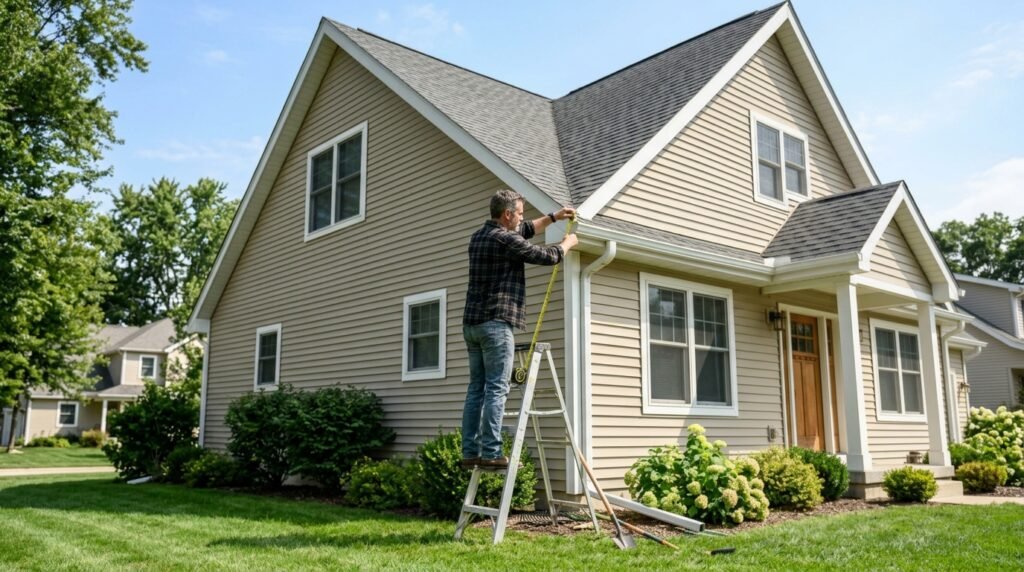
Walk the perimeter of your house and measure the length and width of each section at ground level, right along the exterior walls. If your home is a simple rectangle, this is just two numbers. If it has an L-shape, garage extension, or bump-outs, break it into smaller rectangles and measure each one separately.
Sketch what you’re seeing on graph paper as you go — it makes the next steps much easier, especially on homes with multiple roof sections.
Step 2: Calculate the Base Square Footage
Multiply length × width for each rectangle, then add them together. This gives you the “footprint” square footage — essentially, the square footage of the ground your house covers, not the actual roof surface.
For example, a simple rectangular home that’s 40 feet by 30 feet has a footprint of 1,200 square feet.
Step 3: Determine Your Roof Pitch
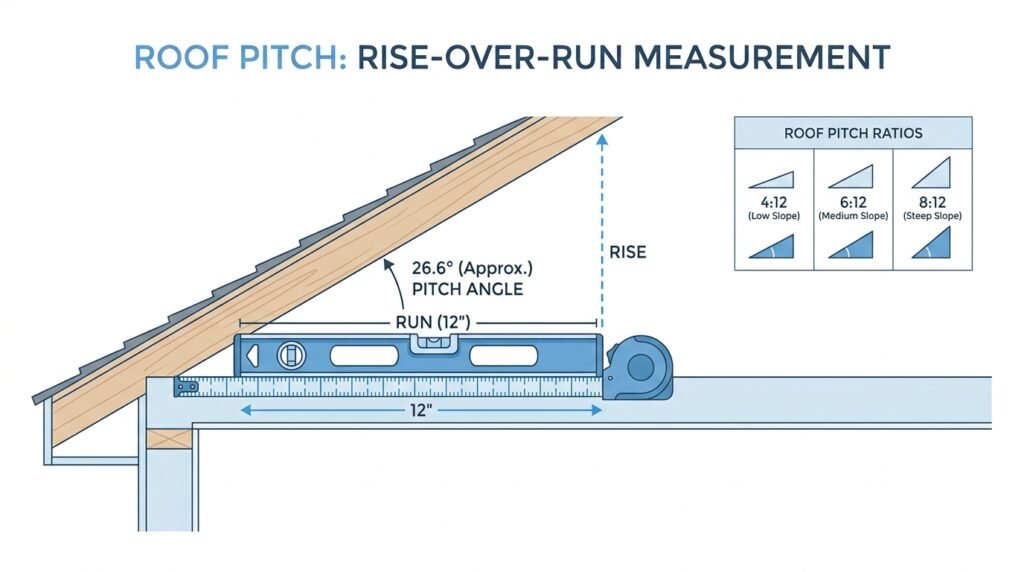
This is the step that trips most people up — and it’s also the most important one. Roof pitch (the steepness of your roof) directly affects how much actual roofing material you need, because a steeper roof has more surface area than the footprint suggests.
Pitch is expressed as a ratio, like 6:12, meaning the roof rises 6 inches for every 12 inches (1 foot) of horizontal run.
Step 4: Apply the Roof Pitch Multiplier
Once you know your pitch, multiply your footprint square footage by the corresponding pitch multiplier (see the chart below) to get your actual roof surface area.
Example: A 1,200 sq. ft. footprint with a 6:12 pitch uses a multiplier of 1.118.
1,200 × 1.118 = 1,342 square feet of actual roof surface
Step 5: Add Overhangs and Eaves
Don’t forget the eaves — the parts of the roof that extend past the exterior walls. Measure the overhang distance (usually 12–24 inches) on all sides and add that extra area to your total. Skipping this step is one of the most common reasons ground estimates come in low.
Step 6: Convert to Roofing Squares
Roofers don’t talk in square feet — they talk in “roofing squares.” One roofing square equals 100 square feet.
Simply divide your total square footage by 100.
1,342 sq. ft. ÷ 100 = 13.4 roofing squares (round up to 14 for material ordering)
How to Estimate Roof Pitch Without Climbing on the Roof
Since pitch is the trickiest part of this whole process, here are three ground-friendly ways to nail it down.
Using Google Earth or Satellite Images
Pull up your address on Google Earth, switch to a 3D or angled view, and visually compare your roofline to reference angles. It won’t be perfectly precise, but it’s a strong starting point.
Using a Smartphone App
Pitch-finder apps (many are free) use your phone’s camera and gyroscope. Stand at a distance where you can see the roofline clearly, line up the app’s on-screen angle indicator with the roof edge, and it’ll estimate the pitch in seconds.
Visual Estimation Method
Stand back far enough to see the full gable end of your house. Compare the roof’s slope to familiar angles — a 4:12 pitch looks fairly gentle, a 6:12 looks moderately steep (common on most homes), and anything above 9:12 starts to look dramatically steep.
Roof Pitch Multiplier Chart
| Roof Pitch | Multiplier |
|---|---|
| 3:12 | 1.031 |
| 4:12 | 1.054 |
| 5:12 | 1.083 |
| 6:12 | 1.118 |
| 7:12 | 1.158 |
| 8:12 | 1.202 |
| 9:12 | 1.250 |
| 10:12 | 1.302 |
| 12:12 | 1.414 |
Multiply your footprint square footage by the number matching your pitch to get true roof surface area.
Common Roof Shapes and How They Affect Your Calculation
Gable Roofs
The simplest shape — two rectangular slopes meeting at a ridge. Easiest to measure and calculate from the ground.
Hip Roofs
Slopes on all four sides instead of two. These generally have a bit more surface area than a gable roof with the same footprint, so measure each face carefully and break the roof into triangular and trapezoidal sections.
Complex/Multi-Plane Roofs
Roofs with dormers, valleys, multiple pitches, or intersecting rooflines are the hardest to estimate from the ground. For these, treat each roof plane as its own mini-project — measure its footprint, determine its pitch, and calculate separately before adding all the sections together.
Tips for Accurate Ground-Level Measurements
- Measure twice, calculate once — small errors compound quickly across a whole roof
- Use satellite images as a cross-check against your physical measurements
- Walk the full perimeter rather than assuming symmetry, especially on older homes
- Round up roofing squares, since materials are sold in full square increments and waste is normal
- Account for waste factor — add 10–15% extra material for cuts, ridges, and complex shapes
Common Mistakes to Avoid
- Forgetting the pitch multiplier — using footprint square footage as roof square footage will always underestimate your needs
- Ignoring overhangs — even a foot of overhang on all sides adds meaningful square footage
- Assuming one pitch for the whole roof — many homes have varying pitches across different sections
- Skipping the sketch — trying to do complex, multi-section roofs from memory leads to errors
When to Call a Professional
A ground-level calculation is excellent for budgeting and comparing quotes, but before any materials are ordered, a roofer should confirm measurements with a final on-roof (or drone) assessment — especially on steep, complex, or multi-story roofs where ground estimates naturally lose precision.
Final Thoughts
Learning how to calculate roof square footage from the ground puts real power in your hands as a homeowner — you’ll understand contractor quotes, spot lowball or inflated estimates, and walk into any roofing conversation with confidence. It’s not about replacing a professional measurement, it’s about being an informed decision-maker before you ever sign a contract.
Grab your tape measure, sketch your roofline, and give it a try. A little math now can save you real money later.
FAQs
Q1: How accurate is a ground-level roof measurement compared to climbing on the roof?
A careful ground measurement is typically within 5–10% of an on-roof measurement, which is accurate enough for budgeting and comparing quotes. Roofers will still confirm exact figures before ordering materials.
Q2: What’s the easiest way to find my roof’s pitch without a ladder?
A smartphone pitch-finder app is usually the fastest and most reliable ground-level method, since it uses your phone’s built-in sensors to measure the angle directly.
Q3: Do I need to measure the chimney or vents separately?
For a general estimate, no — most homeowners round these out of the total since they’re small relative to the whole roof. Professional installers will account for them separately during material ordering.
Q4: How many square feet is a “roofing square”?
One roofing square equals 100 square feet. It’s the standard unit roofers use for material pricing and ordering.