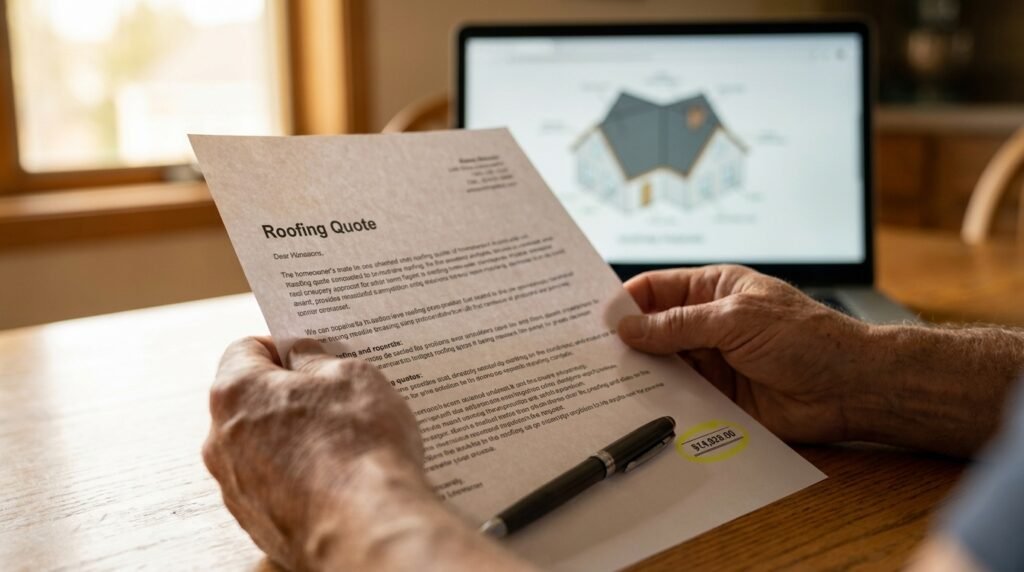
Getting your roof replaced is one of the biggest investments you’ll make in your home. So when three different contractors hand you three wildly different numbers, how do you know which one to trust?
The truth is, spotting red flags in a roofing quote isn’t about finding the cheapest price — it’s about finding the details a shady contractor hopes you’ll skip over. A lowball number, a vague line item, or a rushed sales pitch can all be warning signs that trouble is ahead.
In this guide, we’ll walk through the 10 most common red flags to watch for in a roofing quote, why they matter, and exactly what questions to ask before you sign anything.
Why Reading Your Roofing Quote Carefully Matters
A roofing quote isn’t just a price tag — it’s a roadmap of the entire project. It tells you what materials will be used, how labor is priced, what happens if your decking is rotted, and what protection you have if something goes wrong.
Homeowners who skim past the details often end up with surprise “change orders,” unlicensed subcontractors on their roof, or a warranty that turns out to be worthless. Learning to read between the lines now can save you thousands of dollars — and a massive headache — later.
1. A Price That’s Way Lower Than Every Other Quote
If one estimate comes in thousands of dollars below the rest, that’s not necessarily good news.
An unusually low bid often means the contractor is cutting corners somewhere — cheaper materials, inexperienced labor, or a skipped step like proper flashing or ventilation. It can also mean they’ve deliberately left something out of the quote, only to add it back in later as an “unexpected” charge.
What to do: Ask what’s included in the low quote versus your other bids. If they can’t explain the gap, treat it as a warning sign, not a bargain.
2. Vague or Lump-Sum Pricing
A trustworthy quote breaks the job down item by item: tear-off and disposal, decking repair, underlayment, shingles or metal panels, flashing, ventilation, cleanup, and labor.
If your quote is just one number with no breakdown, you have no way to know where your money is actually going — or where the contractor might cut corners.
What to do: Ask for an itemized estimate listing materials by brand and quantity, not just a total.
3. Demanding Full Payment Upfront
It’s normal for a roofer to ask for a reasonable deposit, especially for jobs that require ordering materials in advance. What’s not normal is being asked to pay the entire cost before a single shingle is removed.
Full upfront payment gives you almost no leverage if the contractor disappears, does poor work, or never finishes the job.
What to do: Look for a payment schedule tied to milestones — for example, a deposit, a payment at material delivery, and a final payment only once the work is complete and inspected.
4. No Proof of License or Insurance
Every legitimate roofing contractor should be able to produce a valid license (where required by your state) and current liability insurance and workers’ compensation coverage.
Without insurance, you could be held financially responsible if a worker is injured on your property or if your home is damaged during the job.
What to do: Ask for their license number and insurance certificate directly — and verify them independently rather than taking their word for it.
5. High-Pressure, Same-Day Sales Tactics
Be cautious of contractors who show up unannounced after a storm, offer a “today only” discount, or pressure you to sign before you’ve had time to think it over.
Reputable roofing companies are usually busy with a steady backlog of work — they don’t need to go door to door chasing storm damage. Urgency is often a tactic to stop you from getting a second opinion.
What to do: Never sign a contract the same day it’s presented unless you’ve already done your research. A good deal today will still be a good deal tomorrow.
6. No Written Contract
A handshake deal or a scribbled note on a business card is not a contract. Everything — scope of work, materials, timeline, payment schedule, and warranty — needs to be in writing.
Without a written agreement, you have little recourse if the finished job doesn’t match what was promised.
What to do: Insist on a detailed, signed contract before any work begins, and keep a copy for your records.
7. Warranty Details Are Missing or Vague
Ask about the warranty, and a legitimate contractor should be able to explain it clearly: what’s covered, for how long, and whether it includes both materials and workmanship.
If the answer is fuzzy, or the warranty is buried in fine print with confusing exclusions, that’s a sign the contractor may not stand behind their work.
What to do: Get the warranty terms in writing, and ask specifically whether it covers labor as well as materials — many “lifetime” warranties only cover the shingles themselves.
8. No Local Address, References, or Online History
A contractor with no permanent business address, no verifiable past clients, and reviews that all appeared within the same week should raise questions.
Fly-by-night roofing outfits — sometimes called “storm chasers” — often follow bad weather from state to state, do rushed work, and vanish before problems surface.
What to do: Ask for the addresses of two or three recent local jobs, and check online reviews across multiple platforms, not just the contractor’s own website.
9. Poor or Inconsistent Communication
How a contractor communicates during the quoting process is a preview of what it’ll be like working with them on your roof.
If they’re slow to respond, dodge direct questions, or give you a different answer every time you ask about the same detail, that inconsistency is unlikely to improve once you’ve signed a contract.
What to do: Pay attention to responsiveness and clarity from the very first phone call — it tells you a lot about what to expect later.
10. Subcontractors With No Accountability
Many roofing companies use subcontracted crews, and that’s not automatically a red flag. The problem arises when the company can’t tell you who will actually be on your roof or takes no responsibility for the subcontractor’s work.
If something goes wrong, you need a clear answer about who is accountable — the company that sold you the quote, or a crew you’ve never heard of.
What to do: Ask directly whether the crew is in-house or subcontracted, and confirm in writing that the company backs the workmanship either way.
How to Compare Roofing Quotes the Smart Way
Once you’ve collected two or three quotes, resist the urge to just look at the bottom line. Instead:
- Line up each quote’s materials, labor, and warranty terms side by side.
- Confirm every quote includes tear-off, disposal, and cleanup.
- Ask each contractor the same set of questions so you’re comparing apples to apples.
- Trust your gut — if something feels rushed or unclear, it probably is.
A little extra time spent comparing quotes now can prevent a costly mistake that follows you for the next 20-plus years.
Final Thoughts
A roofing quote tells you far more than just a price — it tells you how a contractor operates. The red flags above aren’t about being paranoid; they’re about protecting one of the largest investments you’ll make in your home.
Take your time, ask direct questions, and don’t be afraid to walk away from a deal that doesn’t add up. The right roofing contractor will welcome your questions, not rush past them.
Frequently Asked Questions
Q1: What’s a normal deposit for a roofing job?
Most reputable contractors ask for 10–30% upfront, with the rest due at material delivery or project completion. Anything close to 100% upfront is a red flag.
Q2: Why do roofing quotes vary so much between contractors?
Differences in materials, crew experience, overhead, and warranty coverage all affect price. That’s why an itemized breakdown matters more than the bottom-line number.
Q3: Should I always choose the lowest roofing quote?
Not necessarily. An unusually low quote often means missing scope items or lower-quality materials that could cost you more in repairs down the road.
Q4: How do I verify a roofing contractor’s license and insurance?
Ask for their license number and insurance certificate, then confirm both independently through your state’s licensing board or by calling the insurance provider directly.