
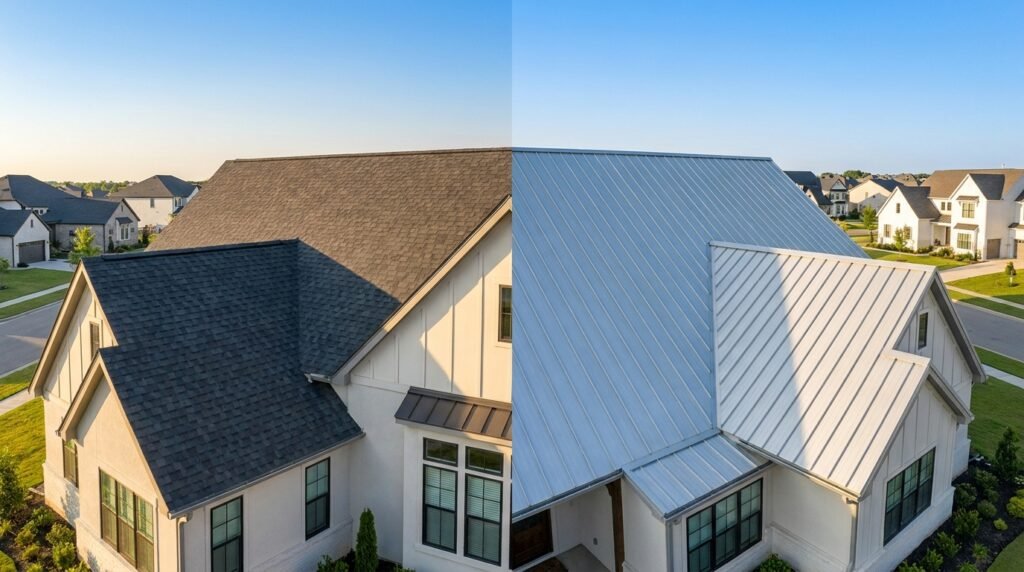
If you’re comparing a metal roof vs asphalt shingles, the sticker price is only half the story. Metal costs more to install — often twice as much — but asphalt shingles rarely last a full 25 years without repairs, and many homeowners end up paying for a second roof before the mortgage is even paid off.
So which one actually costs less over time? In this guide, we’ll break down real installation prices, maintenance costs, energy savings, insurance impacts, and resale value to give you a true 25-year cost comparison — not just the number a contractor quotes you on day one.
Which Is Cheaper Over 25 Years?
For a typical 2,000-square-foot home, asphalt shingles cost roughly $9,000–$17,000 to install, while a standing seam metal roof runs $19,000–$36,000. That makes metal 1.7 to 2.5 times more expensive upfront.
But asphalt shingles typically last 20–30 years, while metal roofs last 40–70 years. Once you factor in maintenance, energy savings, and the real possibility of a second shingle roof within a 25-year window, the gap narrows — and in many climates, metal roofing pulls ahead on true cost per year of ownership.
Let’s dig into the numbers.
Upfront Installation Cost: Metal Roof vs Asphalt Shingles
Asphalt Shingle Roof Cost
Asphalt shingles remain the most common roofing material in the U.S., largely because they’re the cheapest to install. For a 2,000-square-foot roof:
- Basic three-tab shingles: $4–$6 per square foot ($8,000–$12,000 installed)
- Architectural (dimensional) shingles: $4.50–$8.50 per square foot ($9,000–$17,000 installed)
- Premium composite shingles: $7–$10 per square foot ($14,000–$20,000 installed)
Most homeowners choose architectural shingles, which offer better wind resistance and a longer warranty than basic three-tab products.
Metal Roof Cost
Metal roofing costs more because of material and specialized labor, but pricing varies a lot depending on the style:
- Corrugated/exposed-fastener panels: $4–$9 per square foot
- Metal shingles: $7–$14 per square foot
- Standing seam (the most popular and durable style): $9.50–$18 per square foot
For a 2,000-square-foot home, that puts a standing seam metal roof at roughly $19,000–$36,000 installed — a difference of about $10,000–$20,000 compared to architectural shingles.
Why the Price Gap Is So Large
Three main factors drive metal’s higher cost:
- Material cost — steel, aluminum, or copper panels cost more per square foot than asphalt.
- Labor complexity — standing seam installation requires specialized crews and equipment, unlike shingle work, which most roofing companies can do quickly.
- Custom fabrication — many metal roofs are cut and formed to fit the specific roofline, adding to labor time.
Lifespan: How Long Does Each Roof Actually Last?
This is where the real cost story starts to shift.
| Material | Typical Lifespan | Warranty |
|---|---|---|
| Asphalt shingles | 15–30 years (20–25 average) | 25–30 years |
| Metal roofing | 40–70 years (up to 100 for copper) | 30–50 years |
A quality architectural shingle roof, properly installed and maintained, can reach 25–30 years in a mild climate. But in regions with heavy sun, hail, high humidity, or big temperature swings, 15–20 years is more realistic. That means a meaningful number of homeowners will replace their asphalt roof at least once within a 25-year ownership period — effectively doubling their long-term cost.
Metal roofs, by contrast, are usually still performing well at the 25-year mark, with decades of service life remaining.
The True 25-Year Cost Breakdown
Here’s where the comparison gets interesting. Let’s model a 2,000-square-foot home over 25 years, using mid-range national figures.
Asphalt Shingles: 25-Year Cost Estimate
| Cost Category | Estimated 25-Year Cost |
|---|---|
| Initial installation | $13,000 (midpoint) |
| Routine maintenance & minor repairs (~$150–$300/yr) | ~$5,000 |
| Possible second roof (if lifespan falls short of 25 years) | $0–$17,000 |
| Energy savings | None (baseline) |
| Estimated total | $18,000–$35,000 |
Metal Roof: 25-Year Cost Estimate
| Cost Category | Estimated 25-Year Cost |
|---|---|
| Initial installation | $27,000 (midpoint) |
| Routine maintenance (~$0–$100/yr) | ~$1,500 |
| Replacement needed | None expected |
| Energy savings (10–25% lower cooling costs) | -$5,000 to -$8,750 |
| Estimated total | ~$20,000–$23,000 |
What This Means
When you only look at installation day, asphalt wins easily. But stretched across 25 years, the totals move much closer together — and in hot climates where metal’s reflective surface cuts cooling costs significantly, or in homes that need a second shingle replacement, metal can end up cheaper per year of ownership despite the higher upfront bill.
Your actual numbers will depend heavily on your region, roof complexity, and the specific products you choose — but the pattern holds across most cost guides: metal’s advantage grows the longer you stay in the home.
Maintenance and Repair Costs Over Time
Asphalt Shingles
Shingles are cheap and easy to repair, which is a genuine advantage — a missing shingle or minor leak might cost $200–$500 to fix. But they’re also more vulnerable to:
- Wind uplift and cracking
- Granule loss and UV degradation
- Moss and algae growth in humid climates
- Hail damage
Most homeowners budget for an annual inspection plus occasional patch repairs, which adds up over 25 years.
Metal Roofing
Metal panels are far more resistant to wind (120–180 mph vs. 110–130 mph for shingles), impact, and fire. Maintenance is mostly limited to periodic inspections and occasional fastener checks. The trade-off? Repairs, when needed, often require a specialist familiar with metal systems, which can cost more per visit — though you’ll need far fewer visits overall.
Energy Efficiency: Does a Metal Roof Really Save on Cooling Costs?
Yes — and this is one of the most underrated parts of the cost equation. Metal reflects solar radiant heat instead of absorbing it, which can lower cooling costs by 10–25%, especially in warm climates. Asphalt shingles absorb heat and transfer it into the attic, making your HVAC system work harder in summer.
Over 25 years, that efficiency gap can realistically add up to $5,000–$9,000 in saved energy costs — a factor that rarely shows up in a basic roofing quote but matters enormously for true lifetime cost.
Insurance and Resale Value
Insurance Discounts
Many insurers offer 5–35% premium discounts for metal roofs due to their superior wind and fire resistance, particularly in hurricane-prone or wildfire-prone states. Asphalt shingles typically qualify for standard rates only. Check with your insurer, since discounts vary significantly by state and policy.
Resale Value
Metal roofs tend to recoup 85–95% of installation cost at resale, compared to roughly 60–70% for asphalt shingles, and can add 1–6% to a home’s overall value. If you plan to sell within the 25-year window, this narrows the effective cost gap even further.
Which Roof Should You Choose?
Choose Asphalt Shingles If:
- You want the lowest possible upfront cost
- You plan to move within 10–15 years
- Your climate is moderate, without extreme heat, hail, or high wind
- You prefer a wider range of traditional aesthetic options
Choose a Metal Roof If:
- You plan to stay in your home long-term
- You live in a hot, storm-prone, or wildfire-risk area
- You want to minimize maintenance and future replacement costs
- You value energy savings and potential insurance discounts
There’s no universal right answer — the best choice depends on how long you’ll own the home, your local climate, and how much upfront cost you can absorb today versus spread out over decades.
Conclusion
When you compare a metal roof vs asphalt shingles using only the installation quote, asphalt looks like the clear winner. But a true 25-year cost analysis tells a more balanced story: metal’s higher upfront price is offset — sometimes entirely — by its longer lifespan, lower maintenance needs, energy savings, and stronger resale value.
If you’re planning to stay in your home for decades, a metal roof is often the smarter long-term investment. If you need an affordable solution now and don’t plan to stay long, asphalt shingles remain a solid, budget-friendly choice. Either way, get at least three local quotes, ask about warranty terms, and factor in your climate before making the final call.
Frequently Asked Questions
Is a metal roof really worth the extra cost compared to asphalt shingles? For many homeowners, yes — especially those staying long-term or living in hot or storm-prone climates. While metal costs 1.7–2.5 times more upfront, its 40–70 year lifespan, lower maintenance, and energy savings can make its true cost per year competitive with, or lower than, asphalt over a 25-year period.
How many times will I need to replace an asphalt shingle roof in 25 years? It depends on the product and climate. Architectural shingles in mild climates may last close to 25 years, but in harsher climates with intense sun, hail, or humidity, you may need a full replacement once within that window, effectively doubling your material and labor costs.
Do metal roofs actually lower energy bills? Yes. Metal roofing reflects solar heat rather than absorbing it, which can reduce cooling costs by 10–25% in warm climates. Over 25 years, this can add up to several thousand dollars in savings, depending on your region and HVAC usage.
Does a metal roof increase home resale value more than asphalt shingles? Generally, yes. Metal roofs tend to recoup 85–95% of their installation cost at resale and can add 1–6% to a home’s value, compared to roughly 60–70% cost recoupment for asphalt shingle roofs.