
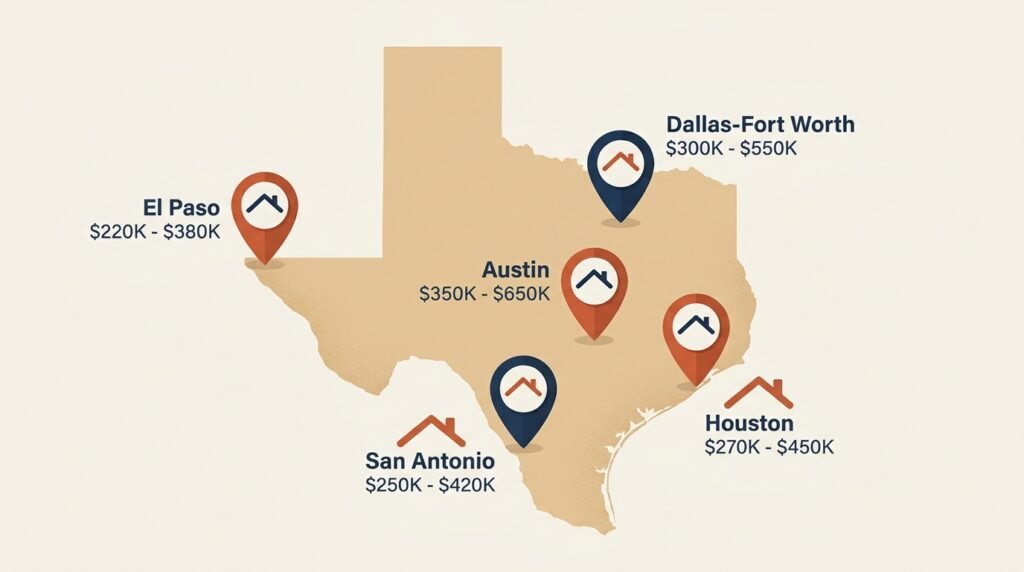
If you’ve started collecting quotes for a new roof, you’ve probably noticed something frustrating: no two numbers match. A neighbor in Dallas paid $9,500. Your cousin in El Paso paid $7,800 for a similar-sized house. A coworker in Austin got quoted $22,000 for metal.
None of these people are wrong. Roofing costs in Texas vary dramatically by city, and understanding why can save you thousands of dollars — or help you spot a lowball bid before it costs you a leak six months later.
This report breaks down 2026 roofing costs across Texas’s major metros, by material, by roof size, and by the local factors — hail history, labor markets, climate — that actually move the price.
Why Roofing Costs Vary So Much Across Texas
Texas isn’t one roofing market. It’s several, stitched together by weather patterns and labor supply.
Coastal urban areas like Houston-Galveston run 5% to 15% above baseline on materials and labor due to higher demand and logistics, while central suburban zones like Dallas-Fort Worth and the Austin suburbs sit closer to baseline pricing with some variability from permit charges, and rural Texas tends to run 5% to 15% lower on labor — though you may pay more to get materials trucked in.
Three forces explain most of the city-to-city gap:
Hail history. Dallas-Fort Worth carries the heaviest hail-claim volume in the state alongside strong labor demand, which pushes repair and replacement pricing higher.
Labor market tightness. Austin also runs higher due to high labor demand and pricier material choices, largely a byproduct of its booming construction sector.
Climate and geography. San Antonio tends to run slightly lower thanks to a more affordable labor and material mix, while El Paso and West Texas see the lowest costs statewide because of lower labor rates, a drier climate, and less storm-driven demand.
Average Roofing Cost in Texas: The Statewide Baseline
Before diving into individual cities, here’s the number every Texas homeowner should know.
The cost to replace a roof in Texas ranges from $5,000 to $25,000 or more, depending on the size, materials, and complexity of the project. For most homeowners, the per-square-foot cost falls between $3.50 and $5.50, though premium materials push that higher.
Broken down by home size:
- Small roofs (1,000–1,500 sq ft): $5,000–$10,000
- Medium roofs (1,500–2,500 sq ft): $10,000–$18,000
- Large roofs (2,500+ sq ft): $18,000–$25,000 or more
At the material level, statewide pricing per “square” (a roofing square equals 100 sq ft) looks like this: asphalt shingles run $300–$450 per square, metal roofs run $700–$1,000, tile roofing runs $800–$1,200, and wood shakes run $600–$800.
Roofing Costs by Texas City (2026)
Here’s how the major metros stack up against each other and against the state average.
Houston
Houston sees the state’s highest storm-repair frequency, driven by hurricane season and hail. The average roof replacement cost in Houston is about $4.65 per square foot, with total project costs ranging from $8,500 to $28,000 based on 2025–2026 market data. Most homeowners land closer to the low end: a standard asphalt roof runs $8,000 to $15,000, with the average around $9,752.
By material, Houston homeowners pay $3.50 to $6.50 per square foot for asphalt shingles and $7.00 to $14.00 per square foot for metal. Labor is a meaningful chunk of that bill — local labor rates in the Houston metro run $2.50 to $6.00 per square foot.
Dallas–Fort Worth
DFW sits in Texas’s most hail-prone corridor, and that shows up in the numbers.
In Dallas, roof replacement typically ranges from $5,000 to $16,000, with asphalt shingles averaging $5,000–$9,500 and per-square pricing between $450 and $750 for asphalt or up to $1,100 for premium materials.
In Fort Worth, homeowners can expect $4.25–$6.75 per square foot, or roughly $8,500–$13,500 total, driven up by the region’s hail corridor and DFW storm season.
Arlington, part of the same metro, sees similar pricing: $4.25–$6.75 per square foot, or $8,500–$13,500 total, due to the same hail corridor and elevated insurance claims.
Austin
Austin is the state’s most expensive major metro for roofing, and labor costs — not materials — are the main reason why.
For a typical 2,000-square-foot home in Austin, homeowners can expect $9,500–$30,000 for a full replacement, with standard asphalt shingles starting around $4.25 per square foot installed and premium standing-seam metal reaching up to $14.00 per square foot. Tear-off alone — required on most Austin homes — now costs $1.50 to $3.25 per square foot.
Other data puts the range slightly tighter: $4.75–$7.25 per square foot, or $9,500–$14,500 total, attributed to tech-driven labor costs and permit fees.
San Antonio
San Antonio is one of the more budget-friendly big-city markets in Texas.
Typical roof replacement runs roughly $8,000 to $18,000 for standard asphalt shingles on a mid-sized home, with per-square-foot pricing of $4.00–$6.50 driven by heat exposure and limestone substrate conditions common in the region. For a typical 1,500- to 2,000-square-foot home, expect $7,000 to $12,000 using standard asphalt shingles.
El Paso
If you’re hunting for the cheapest place to reroof a house in Texas, El Paso wins. Homeowners there pay $3.75–$6.00 per square foot, or $7,500–$12,000 total — the lowest in the state, thanks to extreme UV exposure balanced by low humidity and dry desert climate keeping labor costs down.
Plano
Plano runs on the higher side of the DFW metro at $4.50–$7.00 per square foot, or $9,000–$14,000 total, reflecting its affluent market and more complex rooflines.
Texas Roofing Costs by Material (Statewide, 2026)
Material choice moves your final bill more than almost any other factor. Here’s what each option costs installed, statewide.
3-Tab Asphalt Shingles
$3.00–$4.50 per square foot installed — the budget option, though shorter-lived than architectural shingles.
Architectural (Dimensional) Shingles
$4.50–$7.50 per square foot installed, the most popular choice across Texas thanks to multi-layer laminated construction, 110–130 mph wind resistance ratings, and better waterproofing at overlaps.
Standing Seam Metal
$8.00–$14.00 per square foot installed. It costs more up front, but it lasts 40–70 years, reflects up to 70% of solar radiation, cuts cooling costs by 10–25%, and resists hail far better than shingles — a real advantage in hail-heavy DFW and Austin.
Clay and Concrete Tile
$10.00–$18.00 per square foot installed, especially popular in San Antonio, the Rio Grande Valley, Austin Hill Country, and South Texas, where Spanish Colonial and Mediterranean architecture prevail.
TPO (Flat/Low-Slope Roofs)
$6.32–$10.35 per square foot installed, the standard choice for flat and low-slope roofs across Texas.
Natural Slate
$15.00–$30.00 per square foot installed — the premium option, mostly seen on high-end historic or custom homes.
What Drives Roofing Costs Up (Or Down) in Texas
A handful of variables explain most of the price spread within any single city:
- Roof pitch and complexity — steep or multi-plane roofs need more labor hours and safety equipment.
- Tear-off requirements — removing an old roof adds $1.50–$3.25 per square foot in markets like Austin.
- Underlayment and flashing — waterproofing details matter more in Houston’s rain and DFW’s hail than in dry West Texas.
- Permits — city-by-city fees range from under $200 to $2,000 depending on local code requirements.
- Insurance claims timing — after a major hail event, contractor demand spikes and so do prices, particularly in DFW and Austin.
How to Get an Accurate Quote for Your City
Since pricing swings this much between, say, El Paso and Austin, a generic online calculator won’t get you close. When comparing bids:
- Get at least three quotes from locally based, licensed contractors — not national franchises quoting off a national average.
- Ask for the price per square foot and the total roof area (not floor-plan square footage — actual roof area, including pitch, is usually 10–25% larger).
- Confirm whether tear-off, disposal, and permits are included or billed separately.
- If you’re in a hail-prone area (DFW, Austin), ask specifically about impact-resistant shingle options — they cost more upfront but can lower your homeowner’s insurance premium.
Frequently Asked Questions
How much does a new roof cost in Texas in 2026?
Statewide, expect $5,000 to $25,000 depending on home size and material, with most homeowners landing between $3.50 and $5.50 per square foot for standard asphalt shingles.
Which Texas city has the cheapest roofing costs?
El Paso is generally the most affordable major metro, with per-square-foot pricing around $3.75–$6.00, driven by lower labor rates and a dry climate with fewer storm-related repairs.
Why is roofing more expensive in Austin and Dallas-Fort Worth?
Austin’s costs are pushed up mainly by tight labor demand tied to its construction boom. DFW’s costs are driven by heavy hail-claim volume, which increases both repair frequency and contractor demand.
Is metal roofing worth the extra cost in Texas?
For hail-prone regions like DFW and Austin, often yes — standing seam metal costs more upfront ($8–$14/sq ft) but lasts 40–70 years, resists hail damage, and can cut cooling costs by 10–25% thanks to heat reflection.