If you’ve ever heard a roofer say your house has “a 6/12 roof,” you might have nodded along without really knowing what that meant. You’re not alone.
Roof pitch is simply the measurement of how steep your roof is — expressed as a ratio of vertical rise to horizontal run. It sounds technical, but once you understand the basics, it’s actually pretty simple math.
In this guide, we’ll break down exactly what roof pitch means, how it’s measured, how it converts to degrees, and why it matters more than you might think — whether you’re building a new home, replacing shingles, or just curious about your attic space.
What Is Roof Pitch, Exactly?
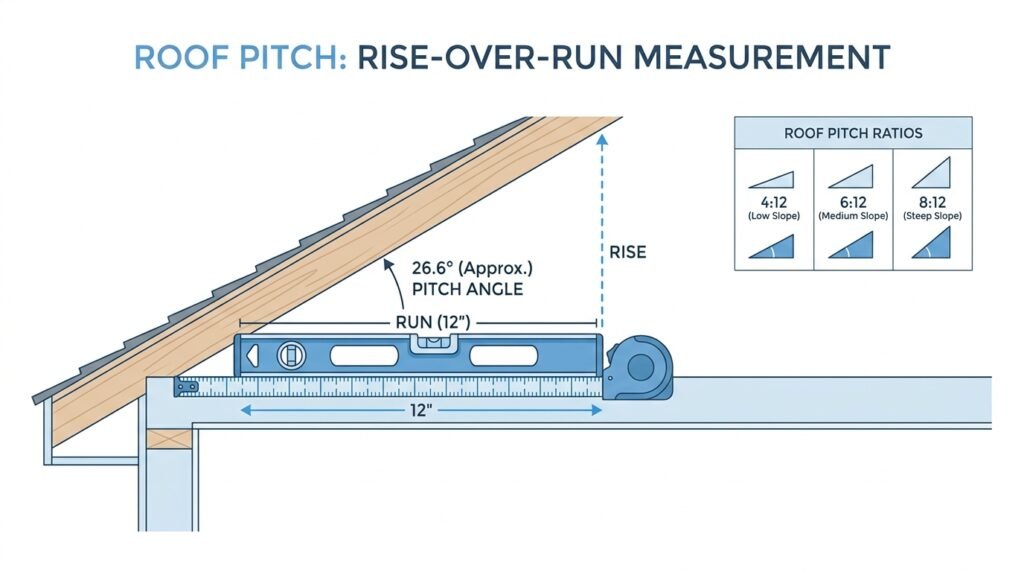
Roof pitch describes the steepness or slope of a roof. It’s written as a ratio — like 4/12 or 8/12 — where the first number represents “rise” (how many inches the roof climbs vertically) and the second number represents “run” (a standard horizontal distance of 12 inches).
So a 6/12 roof pitch means that for every 12 inches the roof extends horizontally, it rises 6 inches vertically. Simple enough, right?
The higher that first number, the steeper the roof. A 2/12 roof is nearly flat. A 12/12 roof forms a dramatic 45-degree angle.
Roof Pitch vs. Roof Slope vs. Roof Angle: What’s the Difference?
These three terms get used interchangeably, but there are subtle distinctions worth knowing:
- Roof pitch — expressed as a ratio (rise/12), like 5/12.
- Roof slope — often used the same way as pitch, though sometimes expressed as a percentage.
- Roof angle — the same steepness expressed in degrees, like 22.6°.
They all describe the same physical characteristic — just in different units. Think of it like describing temperature in Fahrenheit versus Celsius. Same reality, different scale.
How Roof Pitch Is Measured (Rise Over Run Explained)
The 12-Inch Run Standard
In the U.S., roof pitch is almost always measured against a 12-inch horizontal run. That’s why you’ll see pitches written as X/12 — it keeps every roof comparable using the same baseline.
Simple Steps to Measure Your Roof Pitch
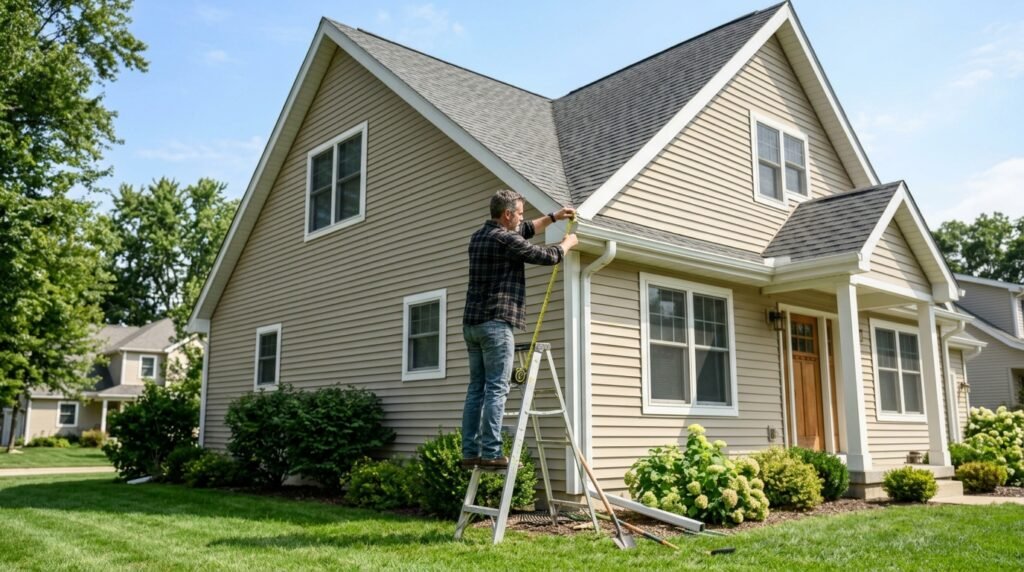
You don’t need to climb onto your roof to figure out its pitch. Here’s an easier way, using your attic or a ladder and a level:
- Grab a level, tape measure, and pencil. A 2-foot level works well.
- Hold the level horizontally against the underside of the roof rafter (in the attic) or against the roof surface itself.
- Measure 12 inches along the level from the roof surface.
- Measure straight down from that 12-inch mark to the roof surface — that vertical measurement is your “rise.”
- Your pitch is that rise number over 12. If you measured 5 inches, your roof pitch is 5/12.
There are also smartphone apps and pitch-finder tools that use your phone’s gyroscope to give you an instant reading — handy if you’d rather skip the math.
Roof Pitch to Degrees Conversion Chart
Want to know your roof’s pitch in degrees instead of a ratio? Here’s a quick reference chart:
| Roof Pitch (rise/run) | Angle in Degrees | Slope Description |
|---|---|---|
| 2/12 | 9.5° | Low slope |
| 3/12 | 14.0° | Low slope |
| 4/12 | 18.4° | Conventional |
| 5/12 | 22.6° | Conventional |
| 6/12 | 26.6° | Conventional |
| 7/12 | 30.3° | Medium-steep |
| 8/12 | 33.7° | Steep |
| 9/12 | 36.9° | Steep |
| 10/12 | 39.8° | Very steep |
| 12/12 | 45.0° | Very steep |
Notice how the degree increase isn’t perfectly linear — that’s because the math relies on the arctangent function (rise divided by run), not a simple straight-line scale.
Common Roof Pitch Types and What They Mean
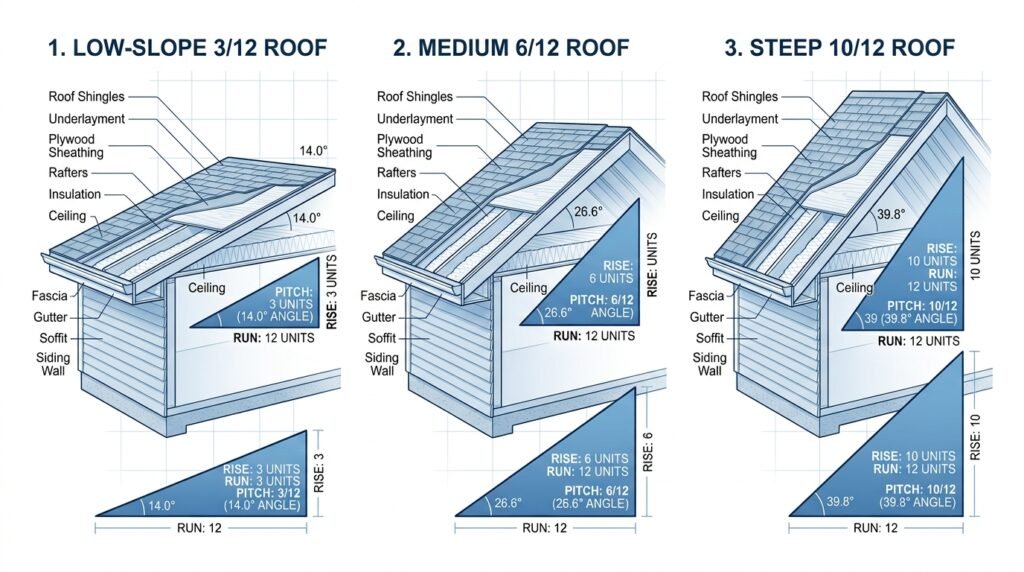
Low-Slope Roofs (2/12 to 4/12)
These roofs look almost flat and are common on modern, minimalist homes, commercial buildings, and additions. They require special waterproof membranes rather than standard shingles, since a gentler slope drains water more slowly.
Conventional Medium-Slope Roofs (4/12 to 9/12)
This is the sweet spot for most residential homes across the U.S. A 6/12 roof pitch in particular is often called the “standard” pitch — steep enough for good drainage, walkable for maintenance, and compatible with nearly every roofing material.
Steep-Slope Roofs (9/12 and Above)
Think Victorian homes, alpine chalets, or churches with dramatic rooflines. These roofs shed snow and rain fast but are harder — and pricier — to work on, often requiring special safety equipment for installation.
How Roof Pitch Affects Your Home
Water and Snow Drainage
Steeper roofs drain water and shed snow more efficiently. If you live somewhere with heavy rainfall or snowfall, a steeper pitch (often 6/12 or higher) helps prevent pooling, ice dams, and structural strain.
Material Choices
Not every roofing material works on every pitch. Low-slope roofs typically need membrane systems like TPO or modified bitumen. Asphalt shingles generally require a minimum pitch of around 2/12 to 4/12 to perform properly. Steeper roofs open up options like slate, wood shakes, or metal panels.
Cost Considerations
Here’s something many homeowners don’t expect: steeper roofs often cost more to build and repair. Why? More surface area means more materials, and the steep angle requires extra safety measures and labor time for roofers.
Attic Space and Interior Design
A steeper pitch creates more usable headroom in an attic — sometimes enough for a bonus room or loft. A lower pitch, on the other hand, often means a shallower, less functional attic space.
How to Calculate Roof Pitch Yourself (Without Climbing on the Roof)
If math isn’t your thing, here’s the formula simplified:
Pitch = Rise ÷ Run (expressed as X/12)
Angle in degrees = arctangent (Rise ÷ Run)
For example, if your rise is 4 inches over a 12-inch run:
- Pitch = 4/12
- Angle = arctan(4/12) = 18.4°
Online roof pitch calculators can do this instantly if you just plug in your rise and run measurements.
Choosing the Right Roof Pitch for Your Climate and Style
If you’re building new or planning a major renovation, your ideal roof pitch depends on a few factors:
- Climate — heavier snow or rain regions typically call for steeper pitches (6/12 or more).
- Architectural style — Craftsman and Colonial homes often use moderate pitches, while modern designs lean toward low-slope or flat rooflines.
- Budget — steeper isn’t always better if cost is a concern.
- Local building codes — some municipalities have minimum pitch requirements based on regional weather patterns.
A good roofing contractor can help you weigh these factors against your specific home and goals.
Frequently Asked Questions
What is considered a “normal” roof pitch?
Most residential homes in the U.S. fall between 4/12 and 9/12, with 6/12 often cited as the most common standard pitch for typical single-family homes.
How do I convert roof pitch to degrees?
Take the rise-over-run ratio and calculate the arctangent of that value. For example, a 6/12 pitch equals roughly 26.6 degrees. You can also use the conversion chart above for quick reference.
Can I install shingles on a low-slope roof?
Generally, asphalt shingles require a minimum pitch of about 2/12 to 4/12, and manufacturers often recommend extra waterproofing underlayment on anything below 4/12.
Does roof pitch affect my homeowners insurance?
It can. Steeper pitches may reduce risk of water pooling and related damage in wet climates, while very steep roofs can sometimes carry higher premiums due to the increased cost and complexity of repairs.
Final Thoughts
Understanding roof pitch isn’t just for contractors — it’s genuinely useful knowledge for any homeowner. Whether you’re planning a roof replacement, building an addition, or simply trying to understand a home inspection report, knowing how to read and calculate roof pitch gives you a clearer picture of your home’s design, durability, and maintenance needs.
Next time someone mentions a “4/12” or “8/12” roof, you’ll know exactly what they’re talking about — rise, run, and everything in between.