You’re standing in the roofing aisle, staring at pallets of shingles. How many should you buy? Buy too few and your project stalls. Buy too many and you waste money.
So, how many shingles do I need for my roof? The short answer: measure your roof area, divide by 100 to get “squares,” and multiply by 3 to get bundles. Then add 10–15% for waste.
This guide walks you through every step with simple math and real examples. By the end, you’ll know exactly what to order.
Shingle Basics: Bundles, Squares, and Coverage
Roofers use a few terms that confuse beginners. Let’s clear them up first.
What Is a Roofing Square?
A square equals 100 square feet of roof. That’s it. A 1,500 sq ft roof is 15 squares.
How Many Bundles Are in a Square?
Most shingles come in bundles. Three bundles cover one square. That means one bundle covers about 33 sq ft.
Some premium or oversized shingles need four or more bundles per square. Always check the package label.
Types of Shingles and Their Coverage
| Shingle Type | Typical Bundles per Square |
|---|---|
| 3-tab asphalt | 3 |
| Architectural (dimensional) | 3 |
| Luxury / designer | 4 or more |
Metric-size shingles can differ a little. The wrapper always lists coverage per bundle, so trust it over any chart.
How to Calculate How Many Shingles You Need (Step by Step)
Here is the full method. Grab a notepad and a calculator.
Step 1: Measure Your Roof Area
You have two easy options.
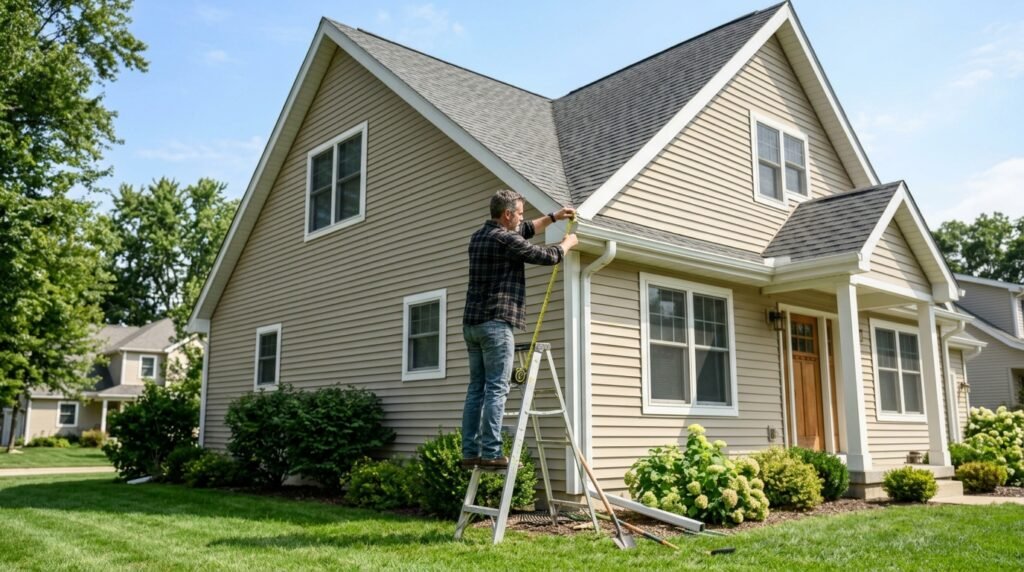
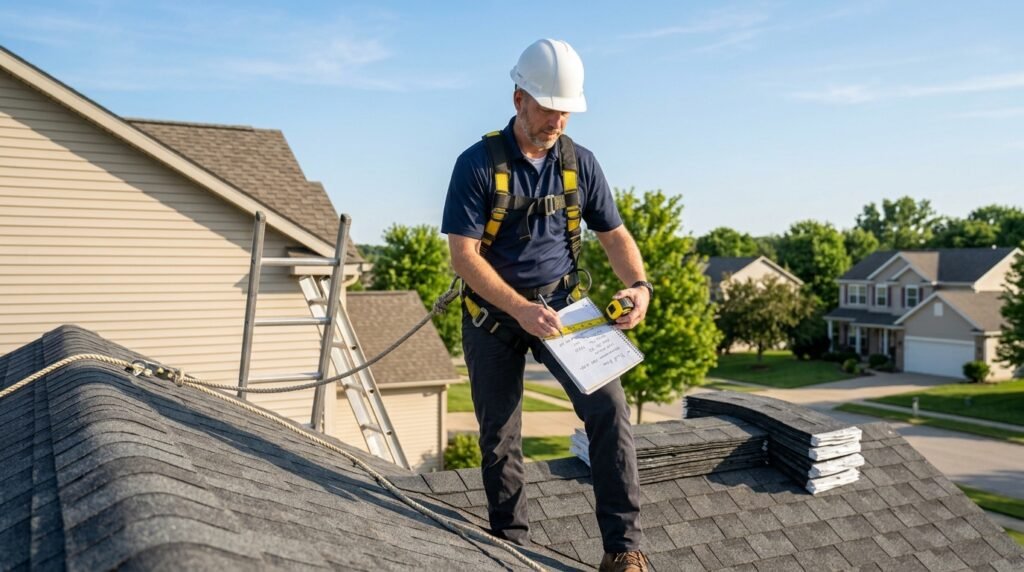
Option A: Measure the roof itself. Safely measure the length and width of each roof section. Multiply them to get each section’s area. Add all sections together.
Option B: Use your home’s footprint. Measure the length and width of your house, including overhangs. Multiply them. Then apply a pitch multiplier (Step 2).
Not comfortable on a ladder? Use Option B from the ground. You can also use satellite measurement tools or ask a roofer for a free estimate.
Step 2: Adjust for Roof Pitch
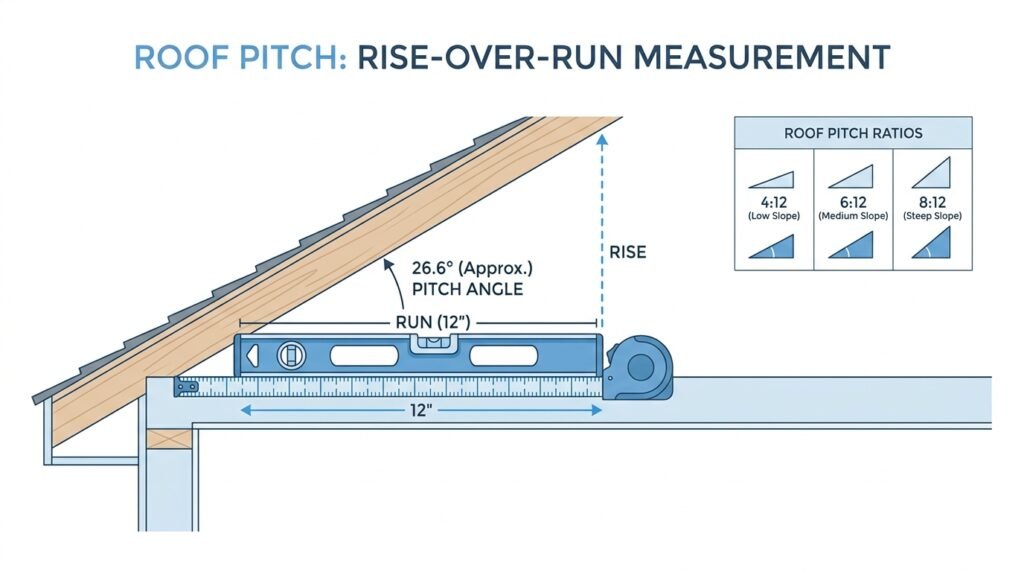
Pitch is how steep your roof is. It’s written as “rise over run,” like 6/12. That means the roof rises 6 inches for every 12 inches across.
A steeper roof has more surface than its footprint suggests. Multiply your footprint by the factor below.
| Roof Pitch | Multiplier |
|---|---|
| 4/12 | 1.054 |
| 5/12 | 1.083 |
| 6/12 | 1.118 |
| 7/12 | 1.158 |
| 8/12 | 1.202 |
| 9/12 | 1.250 |
| 10/12 | 1.302 |
| 12/12 | 1.414 |
Tip: Not sure of your pitch? Place a level on a ladder rung or an attic rafter. Measure 12 inches across, then measure straight up to the roof. That rise number is your pitch.
Step 3: Add a Waste Factor
You will cut shingles at edges, valleys, and hips. Some get damaged too. That’s normal.
- Simple gable roof: add 10%
- Hip roof or many angles: add 15%
- Very complex roof with dormers: add up to 20%
Multiply your roof area by 1.10, 1.15, or 1.20.
Step 4: Convert to Squares
Divide your total (with waste) by 100. Always round up.
Step 5: Convert Squares to Bundles
Multiply squares by 3. That’s your bundle count.
Shingle Calculation Examples
Numbers make this easier. Here are two real-world cases.
Example 1: Simple Gable Roof From the Footprint
Your house is 30 ft by 40 ft with a 6/12 pitch.
- Footprint: 30 × 40 = 1,200 sq ft
- Pitch adjustment: 1,200 × 1.118 = 1,342 sq ft
- Add 10% waste: 1,342 × 1.10 = 1,476 sq ft
- Squares: 1,476 ÷ 100 = 14.76, rounded up to 15 squares
- Bundles: 15 × 3 = 45 bundles
Example 2: Two Roof Planes Measured Directly
Your roof has two flat sections. Each is 40 ft long and 18 ft along the slope.
- Area: 40 × 18 = 720 sq ft per side, so 1,440 sq ft total
- Add 10% waste: 1,440 × 1.10 = 1,584 sq ft
- Squares: 15.84, rounded up to 16 squares
- Bundles: 16 × 3 = 48 bundles
See how easy that was? Once you know the formula, it takes five minutes.
How to Measure Complex Roofs
Not every roof is a simple rectangle. Here’s how to handle trickier shapes.
Break the Roof Into Shapes
Split the roof into rectangles and triangles. Find each area, then add them up.
- Rectangle: length × width
- Triangle: (base × height) ÷ 2
Subtract What Isn’t Shingled
Skylights and large chimneys don’t need shingles. Subtract their area. But if the openings are small, many roofers skip this step. The extra shingles help cover waste around them.
Account for Valleys, Hips, and Dormers
These features increase cutting and waste. That’s why complex roofs need a 15–20% waste factor. If your roof has lots of angles, bump up your order.
Don’t Forget Starter Strips and Ridge Caps
Shingles alone won’t finish the job. You also need a few extras.
Starter Strip Shingles
Starter shingles go along the eaves and rakes. They help seal the first row. Measure the total length of those edges. One bundle usually covers about 100 to 120 linear feet, but check the label.
Ridge Cap Shingles
Ridge caps cover the peak and any hips. Measure the total length of all ridges and hips. A bundle typically covers 20 to 35 linear feet, depending on the brand.
Example: Your ridge is 40 ft long. If a bundle covers 30 ft, you need 2 bundles.
Other Materials to Plan For
A complete roof system also needs:
- Underlayment (felt or synthetic)
- Drip edge
- Ice and water shield in cold climates
- Roofing nails
- Vents and flashing
Ask your supplier to help total these up.
How Much Do Shingles Cost?
Prices vary by region, brand, and style. As a rough guide, a bundle of 3-tab shingles often runs about $30–$45. Architectural shingles usually cost more, often $35–$70 per bundle.
For our 45-bundle example, materials might run from around $1,400 to $3,000. Labor is extra if you hire a pro. Get at least three local quotes before you buy. Prices change, so verify current rates with your supplier.
Common Mistakes When Buying Shingles
Avoid these errors and you’ll save time and money.
- Skipping the waste factor. Running short mid-project is a headache.
- Ignoring pitch. A steep roof needs far more shingles than its footprint suggests.
- Forgetting ridge and starter shingles. These are sold separately.
- Buying mixed batches. Color can vary between production lots. Buy everything at once.
- Not rounding up. Bundles aren’t sold in fractions.
Pro tip: Keep one extra bundle after the job. It’s handy for future repairs, and matching an old color later can be hard.
When to Call a Roofing Professional
DIY math works well for many homes. But call a pro if your roof is very steep, very tall, or highly complex. Safety matters more than savings. A roofer can measure accurately and spot problems like rotted decking before you buy anything.
Also check your local building code. Some areas limit how many layers of shingles a roof can have.
Conclusion
So, how many shingles do I need? Now you know the answer. Measure your roof, adjust for pitch, add waste, and convert to squares. Then multiply by three to get your bundles.
Remember the extras too. Starter strips, ridge caps, and underlayment complete the job. Round up, buy from the same batch, and keep a spare bundle.
With a little math and a good plan, you’ll order the right amount the first time. Ready to start? Grab your tape measure and run the numbers today.
Frequently Asked Questions (FAQs)
How many bundles of shingles do I need for 1,000 square feet?
A 1,000 sq ft roof is 10 squares. That’s 30 bundles. Add 10% waste, and you need about 33 bundles.
How many bundles of shingles cover 1,500 square feet?
1,500 sq ft is 15 squares, or 45 bundles. With 10% waste, plan on about 50 bundles.
How many shingles are in a bundle?
It depends on the type. A typical 3-tab bundle has about 26 to 29 shingles. Architectural bundles often have around 20 to 22. Each bundle covers roughly 33 sq ft.
Should I buy extra shingles?
Yes. Always add 10–15% for cuts, mistakes, and damaged pieces. Complex roofs need even more.