If you’re staring at a leaking flat roof and three confusing membrane names, you’re not alone. TPO vs EPDM vs modified bitumen is one of the most common questions property owners ask before a flat roof replacement — and for good reason. The material you pick affects your upfront budget, your energy bills, and how many times you’ll be writing this check again over the next 20 years.
In this guide, we’ll break down real 2026 pricing, lifespan expectations, and pros and cons for each roofing system, so you can walk into a contractor bid with confidence instead of guesswork.
What Is a Flat Roof, and Why Does Material Choice Matter So Much?
Flat roofs (technically “low-slope” roofs) are common on commercial buildings, apartment complexes, and modern homes. Because there’s little to no pitch to shed water, the roofing membrane has to do all the waterproofing work — which makes material selection far more critical than it is on a sloped shingle roof.
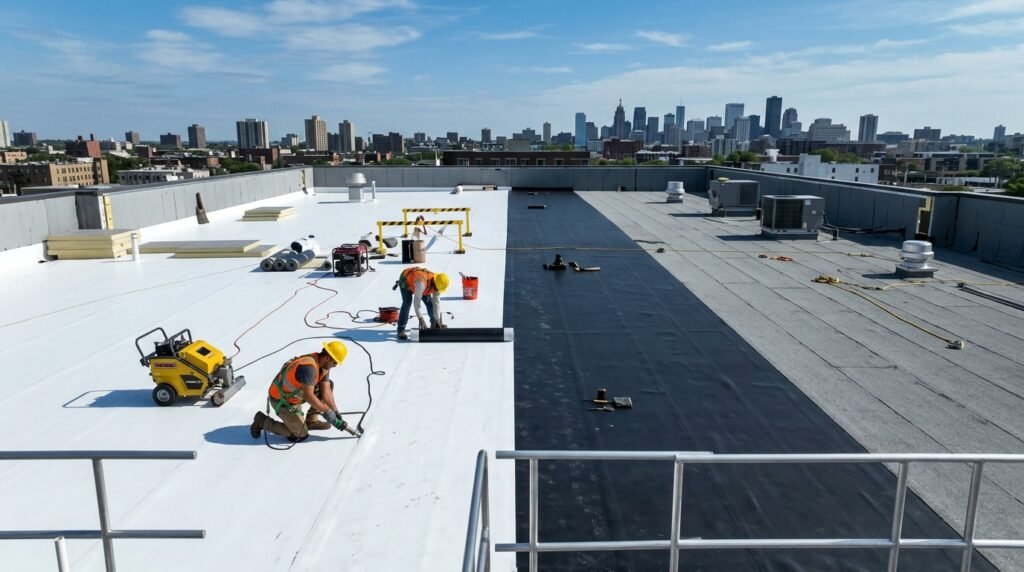
Commercial flat roofs typically use single-ply membranes like EPDM, TPO, or PVC, modified bitumen, or spray-applied polyurethane foam systems. The three most popular and cost-competitive options remain TPO, EPDM, and modified bitumen — which is exactly why comparing their costs matters so much before you sign a contract.
Quick Comparison: TPO vs EPDM vs Modified Bitumen
| Factor | TPO | EPDM | Modified Bitumen |
|---|---|---|---|
| Installed Cost (per sq ft) | $4 – $14 (avg ~$8.75) | $4 – $13 | $4 – $9.50 (up to $20 with heavy insulation) |
| Lifespan | 20–30 years | 15–25 years | 12–20+ years |
| Seam Method | Heat-welded | Adhesive/tape | Torch or self-adhered layers |
| Energy Efficiency | High (reflective white membrane) | Low (typically black) | Moderate (granulated cap reflects some heat) |
| Best For | Energy-conscious owners, moderate climates | Budget buyers, cold climates | High foot-traffic roofs, older buildings |
Cost ranges reflect national 2026 averages and vary by region, roof size, and insulation needs.
TPO Roofing Cost Breakdown
TPO (thermoplastic polyolefin) has become the most widely installed single-ply commercial roofing membrane in the U.S., and it’s increasingly popular on residential flat roofs too.
How Much Does TPO Cost?
TPO roofing averages around $8.75 per square foot installed, with a typical range of $4 to $14 per square foot. On the budget end, a basic 45-mil ballasted TPO system can start around $4.15 per square foot, while a premium fully-adhered system with above-deck insulation can run as high as $20 per square foot.
Why TPO Costs What It Does
TPO’s price reflects its performance. It requires minimal maintenance, offers watertight heat-welded seams, and is known for energy efficiency, UV resistance, and reflective qualities that can lower cooling costs. That reflectivity is a big deal in hot climates — a white TPO roof can meaningfully reduce your air conditioning load during summer months.
TPO Pros and Cons
Pros:
- Highly energy-efficient (reflects heat instead of absorbing it)
- Strong, heat-welded seams resist leaks
- Lightweight and easy to install
- Good chemical and puncture resistance
Cons:
- Quality varies significantly between manufacturers
- Seam failures can occur with poor installation
- Slightly less proven long-term track record than EPDM
EPDM Roofing Cost Breakdown
EPDM (ethylene propylene diene monomer), often called “rubber roofing,” has been a flat roof staple since the 1960s.
How Much Does EPDM Cost?
EPDM, also known as rubber roofing, typically costs between $5 and $13 per square foot installed, though some overlay systems without insulation can come in as low as around $5 per square foot on the commercial side. It generally sits at or slightly below TPO in overall project cost.
Why Choose EPDM?
Rubber flat roofs resist damage from sun exposure, heavy snow, wind, and hail — making EPDM a favorite in colder, harsher climates where flexibility in freezing temperatures matters. It’s also one of the simplest systems to repair, since patching a rubber membrane is generally straightforward and inexpensive compared to other systems.
EPDM Pros and Cons
Pros:
- Lower average material cost
- Excellent flexibility in cold weather
- Easy, affordable repairs
- Long track record of real-world performance
Cons:
- Typically black, which absorbs heat (though white EPDM exists)
- Adhesive seams are more prone to failure than heat-welded seams
- Less energy-efficient than TPO in hot climates
Modified Bitumen Roofing Cost Breakdown
Modified bitumen is essentially an evolution of traditional built-up tar roofing, reinforced with rubber or plastic polymers for added flexibility and strength.
How Much Does Modified Bitumen Cost?
Modified bitumen roofing typically costs between $4.50 and $9.50 per square foot, with total project costs ranging from about $4,800 to $18,000 depending on roof size and labor. On larger or more complex jobs, a full modified bitumen roof system can range from around $9 per square foot for a basic 2-ply system with no insulation up to $20 per square foot for a 3-ply system meeting higher energy code insulation requirements.
Why Choose Modified Bitumen?
Modified bitumen is far more puncture-resistant than single-ply membranes like EPDM or TPO, making it a strong choice for roofs with heavy foot traffic, such as apartment buildings where tenants access the roof. It requires skilled, careful installation, though — neglecting the seams during installation can create weak points that compromise the roof’s integrity over time.
Modified Bitumen Pros and Cons
Pros:
- Excellent puncture and impact resistance
- Reflective, light-colored granulated cap options available
- Handles heavy foot traffic well
- Multiple layers add redundancy against leaks
Cons:
- Higher installation cost than basic EPDM
- Requires skilled labor (torch-down installation carries fire risk if done improperly)
- Heavier than single-ply membranes
Side-by-Side: Total Cost Over Time
Upfront price isn’t the full story. A cheaper roof that needs replacing sooner can cost more over 20–30 years than a pricier, longer-lasting system.
- TPO: Higher potential lifespan (20–30 years) plus energy savings from reflectivity can offset a higher initial price tag.
- EPDM: Lower upfront cost and cheap repairs make it a strong value pick, especially in cold climates where lifespan tends to run 15–25 years.
- Modified Bitumen: Mid-range pricing with strong durability against foot traffic, but a shorter average lifespan than TPO in most installations.
If you’re budgeting for the long haul, it’s worth asking your contractor for a cost-per-year-of-service estimate rather than comparing raw square-foot prices alone.
Factors That Affect Your Final Flat Roof Price
Whichever material you choose, these variables can shift your final quote significantly:
- Roof size — larger roofs typically have a lower cost per square foot due to labor efficiencies.
- Insulation requirements — meeting higher R-value energy codes can add several dollars per square foot.
- Roof removal — tearing off an old roof typically costs $1 to $5 per square foot, or roughly $1,000 to $1,500 total on average.
- Labor rates — local labor generally runs $3 to $7 per square foot, making up 20% to 30% of the total bill.
- Roof accessibility — dense urban environments or multi-story buildings can add significant logistical costs.
- Number of penetrations — vents, skylights, and HVAC units all add flashing labor and material.
How to Choose the Right Material for Your Budget
Ask yourself these questions before deciding:
- What’s my climate like? Hot and sunny → TPO’s reflectivity pays off. Cold and freeze-prone → EPDM’s flexibility shines.
- Will people be walking on this roof regularly? If yes, modified bitumen’s puncture resistance may be worth the extra cost.
- How long do I plan to own this property? Short-term ownership may favor the lower upfront cost of EPDM; long-term ownership often favors TPO’s efficiency and lifespan.
- What’s my insulation situation? If you need to hit strict energy codes, factor that added cost into every material option equally.
There’s no universally “best” choice here — the right answer depends on your climate, your building’s use, and how long you plan to keep it.
Conclusion
When comparing TPO vs EPDM vs modified bitumen for your flat roof, the cheapest option upfront isn’t always the smartest long-term investment. TPO offers energy savings and a longer lifespan at a moderate-to-higher price. EPDM delivers reliable, budget-friendly performance, especially in cold climates. Modified bitumen brings unmatched puncture resistance for high-traffic roofs at a mid-range price point.
The best move? Get at least three quotes from licensed roofing contractors, ask about warranty terms, and factor in your climate and how the building will be used — not just the price per square foot.
Frequently Asked Questions
Q1: Which is cheaper, TPO or EPDM?
EPDM is generally slightly cheaper than TPO on a per-square-foot basis, though both fall within a similar $4–$14 range depending on thickness, insulation, and installation method.
Q2: How long does a TPO roof last compared to EPDM and modified bitumen?
TPO typically lasts 20–30 years, EPDM around 15–25 years, and modified bitumen roughly 12–20 years, though quality installation and maintenance can extend any of these ranges.
Q3: Is modified bitumen worth the extra cost over EPDM?
If your roof gets regular foot traffic or you’re in a building with frequent rooftop access, modified bitumen’s puncture resistance often justifies its higher price point.
Q4: Does roof color affect flat roof costs?
Yes — white or reflective membranes (common with TPO) often cost slightly more upfront but can reduce cooling costs, which may offset the price difference over time.