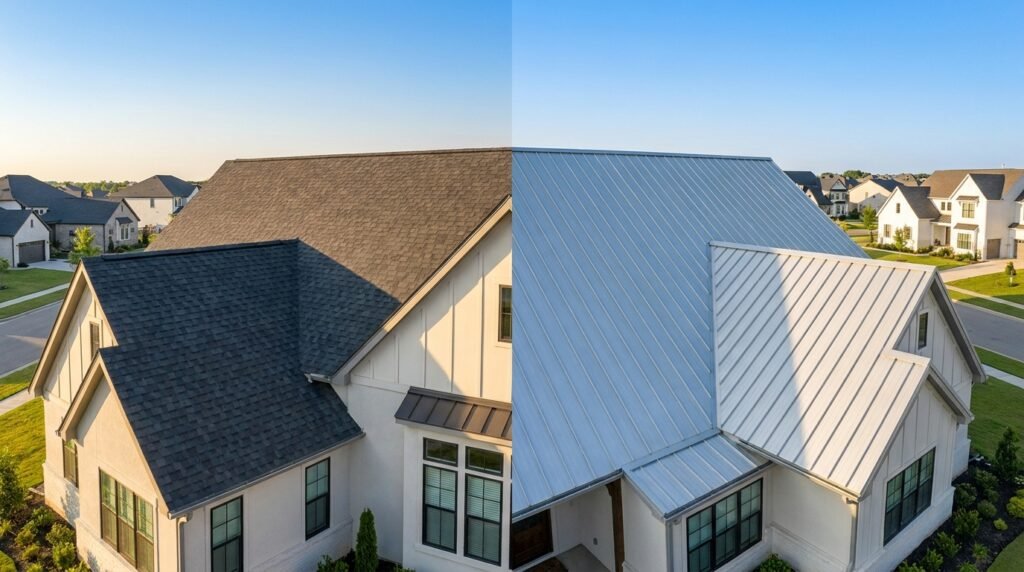
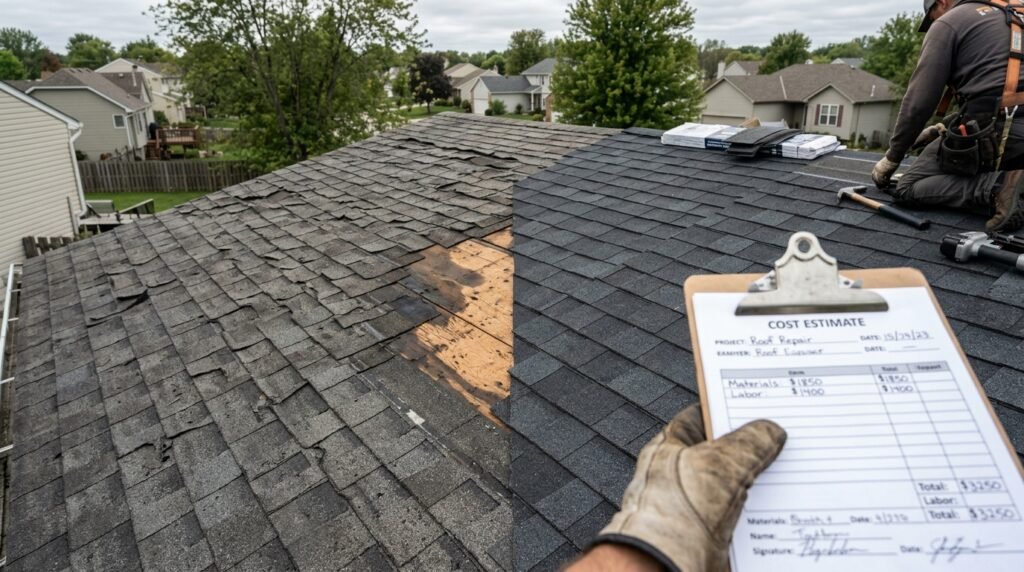
Staring up at a water stain on your ceiling, one question hits harder than any other: do you patch it, or do you replace the whole roof?
The roof repair vs roof replacement decision isn’t just about how bad the damage looks. It’s about money — specifically, the point where paying for repairs stops making financial sense and a full replacement becomes the smarter buy.
In this guide, you’ll get an exact break-even formula roofing pros use internally, plus the real-world numbers, warning signs, and material-specific math to apply it to your own roof.
Why “How Old Is My Roof?” Isn’t the Right Question
Most homeowners ask the wrong question first. They ask “how old is my roof?” when they should be asking “what does each additional year of life actually cost me?”
Age matters, sure. But two 15-year-old roofs can be in completely different shape depending on material, climate, ventilation, and maintenance history. A formula that only looks at age will steer you wrong.
That’s why contractors use a cost-per-year comparison instead of a gut feeling. It removes the guesswork.
The Exact Break-Even Formula for Roof Repair vs Replacement
Here’s the formula, broken into steps you can actually calculate with two phone quotes.
Step 1: Get Your Repair Cost (R)
Call a licensed roofer and get a firm quote for fixing the current problem — not a ballpark, an actual number.
Step 2: Get Your Full Replacement Cost (F)
Get a separate quote for a full tear-off and replacement using the material you’d choose today.
Step 3: Estimate Remaining Life After Repair (r)
Ask the contractor: “If I repair this, how many more years will the roof realistically last?” Be skeptical of vague answers — push for a number.
Step 4: Estimate Full Lifespan After Replacement (L)
New asphalt shingle roofs typically run 20–25 years, metal 40–50 years, and tile 50+ years, depending on installation quality and climate.
Step 5: Calculate the Annualized Cost of Each Option
This is where the real answer lives:
Annualized Repair Cost = R ÷ r
Annualized Replacement Cost = F ÷ L
Whichever number is lower is the financially smarter option — as long as it also passes the 50% sanity check below.
Step 6: Apply the 50% Rule as a Backstop
Even if annualized repair cost looks lower, most roofing professionals recommend replacing outright once repair cost crosses 50% of full replacement cost. Why? Because a roof that needs repairs costing that much is usually signaling deeper, system-wide failure — not an isolated problem.
Worked Example: Real Numbers
Let’s say you get these quotes:
- Repair cost (R): $1,400
- Remaining life after repair (r): 4 years
- Replacement cost (F): $13,000
- Lifespan after replacement (L): 25 years
Run the math:
- Annualized repair cost = $1,400 ÷ 4 = $350/year
- Annualized replacement cost = $13,000 ÷ 25 = $520/year
In this case, repair wins — it’s cheaper per year, and the repair cost is nowhere near 50% of replacement cost. Repairing buys you time without overpaying.
Now flip the numbers: repair cost jumps to $6,800 because the deck is compromised. That’s over 50% of the $13,000 replacement quote. Even if the annualized math looks close, the 50% rule says: replace.
Signs You Should Repair, Not Replace
Not every roof problem needs the formula — sometimes the signs alone make the call obvious.
Isolated, localized damage. A single cracked flashing seal or a handful of missing shingles after a storm is a textbook repair situation.
Roof under 10 years old. Younger roofs have plenty of life left, and repairs are usually cheap relative to full replacement.
One-time storm event with insurance coverage. If your policy covers the damage and the rest of the roof is sound, repair is almost always the right move.
Signs You Should Replace, Not Repair
On the flip side, certain patterns are your roof telling you it’s done negotiating.
Roof age over 20 years (asphalt). You’re statistically near end-of-life regardless of current condition.
Multiple repair calls within 12 months. If you’ve paid for three “small fixes” in one year, you’re not saving money — you’re financing a slow-motion replacement.
Widespread granule loss or curling shingles. This is systemic wear, not a localized fix.
Sagging deck or structural movement. This is a safety issue, not a cosmetic one — replacement isn’t optional here.
Roof Repair vs Replacement Cost Comparison (2026)
Here’s what typical national averages look like right now, though local labor and material costs will shift these numbers.
Average repair costs by issue:
- Minor shingle repair: $150–$500
- Flashing repair: $200–$500
- Leak repair (localized): $300–$1,200
- Storm damage patch: $500–$3,000
Average replacement costs by material:
- Asphalt shingles: $8,500–$16,000
- Metal roofing: $15,000–$30,000
- Tile roofing: $20,000–$45,000
- Slate roofing: $25,000–$50,000+
Notice the spread. A $1,500 repair on a $9,000 asphalt roof is a no-brainer repair. That same $1,500 repair on a system where full replacement is only $8,500 starts creeping toward the 50% threshold fast.
How Roofing Material Changes the Break-Even Point
The math shifts depending on what’s on your house.
Asphalt Shingles
Cheapest to repair and replace, but also the shortest lifespan. Break-even tips toward replacement faster because annualized replacement cost is low.
Metal Roofing
High upfront replacement cost, but the long lifespan (40–50 years) makes annualized cost surprisingly competitive — often favoring repair for much longer than asphalt.
Tile and Slate
Repairs can be tricky to source (matching tiles, specialty labor), sometimes making repair costs disproportionately high relative to the damage. Get multiple quotes before assuming replacement is cheaper.
Insurance, Warranty, and Resale Value Considerations
The formula covers pure economics, but three other factors can tip the scale.
Does Insurance Cover Repair or Replacement?
If a covered event (hail, wind, fallen tree) caused the damage, your insurer may pay for repair or full replacement depending on the extent of damage and your policy’s actual cash value vs. replacement cost coverage. Always get a claims adjuster’s assessment before committing either way.
How Replacement Affects Resale Value
A brand-new roof is one of the few renovations that consistently returns a strong percentage of its cost at resale, and it removes a major negotiating point for buyers. If you’re selling within 2–3 years, factor that into your break-even decision even if repair looks cheaper on paper.
Common Mistakes Homeowners Make in This Decision
Even smart homeowners fall into a few predictable traps.
They chase the cheapest repair quote without asking about remaining lifespan — so they don’t actually know their “r” value.
They skip getting a second replacement quote, assuming one number represents the market.
They ignore the 50% rule and keep throwing money at a dying roof, one small repair at a time, until they’ve spent replacement-level money without getting a new roof.
Have you added up everything you’ve spent on your roof in the last two years? For a lot of homeowners, that number is more revealing than any single quote.
Final Thoughts
The roof repair vs roof replacement decision doesn’t have to be a gut call. Run the numbers: get your repair quote, your replacement quote, and honest lifespan estimates for both. Divide cost by years, check it against the 50% rule, and you’ll have a defensible, data-backed answer instead of a guess made under a leaking ceiling.
When in doubt, get two independent roofer assessments — a second opinion on remaining lifespan often changes the math more than people expect.
Frequently Asked Questions
Is it cheaper to repair a roof or replace it?
Repair is almost always cheaper up front, but the real comparison is annualized cost — repair cost divided by remaining years of life, compared to replacement cost divided by the new roof’s full lifespan.
What is the 50% rule for roof replacement?
It’s a rule of thumb stating that if repair costs exceed 50% of full replacement cost, replacement is usually the smarter long-term investment, since that level of damage often signals deeper structural issues.
How do I know if my roof needs a full replacement?
Key signs include age over 20 years (asphalt), multiple repairs within the past year, widespread granule loss or curling shingles, and any sagging in the roof deck.
Does homeowners insurance cover roof replacement or just repair?
It depends on your policy and the cause of damage. Sudden, covered events like hail or storms may qualify for repair or full replacement, while gradual wear typically isn’t covered at all.