Your flat roof is leaking, and now you’re staring at three confusing material names. Which one should you pick? And what will it cost?
The average flat roof replacement cost in 2026 runs about $4 to $10 per square foot, or roughly $6,000 to $15,000 for a typical 1,500 sq ft roof. Your final price depends on the material, the roof’s condition, and where you live.
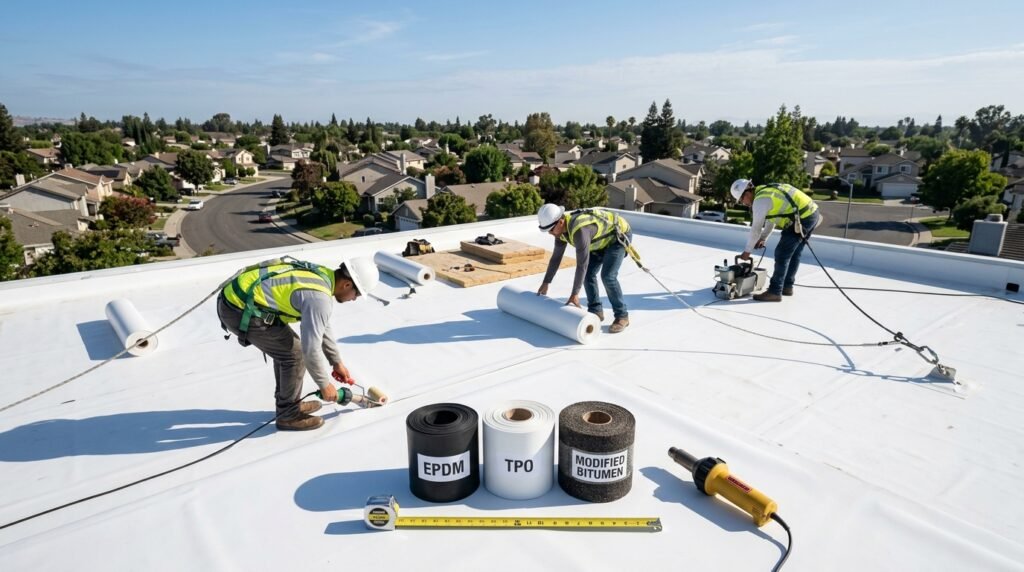
This guide compares TPO, EPDM, and modified bitumen side by side. You’ll see real price ranges, lifespans, pros and cons, and tips for getting a fair quote.
Note: Prices below reflect national averages from major cost guides (Angi, HomeAdvisor, and contractor estimators). Local quotes will vary.
How Much Does Flat Roof Replacement Cost in 2026?
Most homeowners pay between $4 and $10 per square foot installed. That includes materials, labor, and basic tear-off.
Roofers also price by the “square,” which is 100 square feet. So $7 per square foot equals $700 per square.
Flat roofs usually cost more than shingle roofs. Contractors often charge 20% to 35% more because of the specialized membranes and the detail work around edges, drains, and vents.
Average Cost by Roof Size
| Roof Size | Low-End Cost | High-End Cost |
|---|---|---|
| 500 sq ft (garage, porch) | $2,000 | $5,000 |
| 1,000 sq ft | $4,000 | $10,000 |
| 1,500 sq ft | $6,000 | $15,000 |
| 2,500 sq ft | $10,000 | $25,000 |
Want a quick estimate? Measure your roof’s length and width, multiply them, then multiply by your material’s per-square-foot price below.
Flat Roof Replacement Cost by Material: Quick Comparison
Here’s how the three most popular flat roof materials stack up.
| Feature | EPDM (Rubber) | TPO | Modified Bitumen |
|---|---|---|---|
| Installed cost per sq ft | $5 – $9 | $5 – $10 | $4 – $8 |
| Typical lifespan | 25 – 30 years | 15 – 25 years | 15 – 20 years |
| Cost for 1,500 sq ft | $7,500 – $13,500 | $7,500 – $15,000 | $6,000 – $12,000 |
| Best for | Cold climates, tight budgets | Hot climates, energy savings | Heavy foot traffic, multi-layer protection |
| Energy efficiency | Low (black) | High (white, reflective) | Moderate |
Prices can climb on complex jobs. Some guides report EPDM and TPO ranges stretching toward $13 to $15 per square foot for premium installs or high-cost cities like New York.
TPO Roofing Cost: Is It Worth It?
TPO (thermoplastic polyolefin) is a white, single-ply membrane. It has become one of the most popular flat roof choices in the U.S.
TPO Cost per Square Foot
Expect $5 to $10 per square foot installed. The membrane itself costs about $1.50 to $2.50 per square foot. Labor and accessories make up the rest.
TPO Pros
- Reflects heat. The white surface can lower cooling bills in sunny states.
- Heat-welded seams. Strong seams mean fewer leaks.
- Mid-range price. It costs less than PVC but offers similar benefits.
TPO Cons
- Quality varies by brand. Many manufacturers make TPO, and cheaper products may fail early.
- Shorter track record. It hasn’t been around as long as EPDM.
- Shorter lifespan. Expect 15 to 25 years, depending on quality.
Is TPO right for you? If you live somewhere hot and want lower energy bills, it’s a strong pick. Just choose a reputable brand and a certified installer.
EPDM Roofing Cost: The Rubber Roof Option
EPDM (ethylene propylene diene monomer) is a synthetic rubber membrane. It has protected flat roofs for over 50 years.
EPDM Cost per Square Foot
Most homeowners pay $5 to $9 per square foot. Thicker membranes (60 mil vs. 45 mil) and fully adhered installs cost more than ballasted ones.
EPDM Pros
- Long lifespan. Many EPDM roofs last 25 to 30 years.
- Handles cold well. It stays flexible in freezing temperatures.
- Easy to repair. Patches are simple and inexpensive.
- Proven performance. It has decades of real-world data behind it.
EPDM Cons
- Black surface absorbs heat. This can raise cooling costs in hot climates.
- Glued seams. Seams rely on adhesives and can fail if installed poorly.
- Punctures happen. Falling branches or heavy foot traffic can tear it.
If you want the best long-term value per year, EPDM is hard to beat.
Modified Bitumen Roofing Cost: The Layered Alternative
Modified bitumen (often called “mod bit”) is an asphalt-based roofing sheet reinforced with polymers. Installers apply it by torch, hot mop, or self-adhesive backing.
Modified Bitumen Cost per Square Foot
Plan on $4 to $8 per square foot, with an average near $6. It is often the cheapest of the three upfront.
Modified Bitumen Pros
- Tough surface. The multi-layer build stands up well to foot traffic.
- Lower upfront cost. Great if you’re on a tight budget.
- Good for complex roofs. It handles curbs, vents, and odd shapes well.
Modified Bitumen Cons
- Shorter lifespan. Most last 15 to 20 years.
- Torch-down risk. Open flame installation raises fire concerns, so ask for a cold-applied option.
- Heavier. It adds more weight to your roof structure.
TPO vs EPDM vs Modified Bitumen: Which Is Best?
There’s no single winner. The best flat roof replacement depends on your climate, budget, and how you use the roof.
Best for Hot Climates: TPO
Its reflective white surface keeps your building cooler. Homeowners in Texas, Arizona, and Florida often see energy savings.
Best for Cold Climates: EPDM
Rubber stays flexible when temperatures drop. It resists cracking from freeze-thaw cycles.
Best for Tight Budgets: Modified Bitumen
It usually has the lowest upfront price. Just remember it may need replacing sooner.
Best for Roof Decks and Foot Traffic: Modified Bitumen or TPO
Both resist punctures better than thin EPDM. Add walkway pads for extra protection.
Cost Per Year of Service
Cheap isn’t always cheaper. Here’s a rough yearly cost, using mid-range prices:
- EPDM: about $7/sq ft ÷ 27 years = ~$0.26 per sq ft per year
- TPO: about $7.50/sq ft ÷ 20 years = ~$0.38 per sq ft per year
- Modified bitumen: about $6/sq ft ÷ 17.5 years = ~$0.34 per sq ft per year
On this math, EPDM often wins on long-term value. TPO can close the gap if energy savings are high.
What Affects Flat Roof Replacement Cost?
Material is only one piece. Here’s what else moves your quote.
Roof Size and Shape
Bigger roofs cost more in total, but the per-square-foot price often drops. Roofs with many vents, skylights, or corners cost more per foot.
Tear-Off and Disposal
Removing your old roof costs about $1 to $5 per square foot. Two layers cost more than one.
Insulation
Replacing damaged insulation adds $1 to $5 per square foot. Upgrading to code-required R-values can raise the price further.
Roof Deck Repairs
Rotted plywood or structural damage must be fixed first. Hidden damage is one of the biggest surprise costs.
Labor and Location
Labor can make up a large share of the total. Big cities and high-cost regions run 30% to 50% higher than rural areas.
Permits and Warranties
Permits may add a few hundred dollars. Longer manufacturer warranties usually cost more upfront but protect you later.
Roof Coatings and Add-Ons
Reflective or waterproof coatings add $1 to $3 per square foot. They can extend roof life if applied at the right time.
Replace or Repair? When to Choose a Full Flat Roof Replacement
Not every leak means a new roof. Repairs often run $300 to $1,500 for small problems. But replacement makes sense when:
- Your roof is near or past its lifespan
- You have repeated leaks in different spots
- Water is trapped in the insulation
- Repairs now cost more than 30% to 40% of a new roof
- You see widespread blistering, cracking, or ponding water
A good contractor will test for moisture and explain your options honestly.
How to Save Money on Your Flat Roof Replacement
You don’t need to cut corners to cut costs. Try these smart moves:
- Get three or more quotes. Compare materials, warranty terms, and scope, not just price.
- Schedule in the off-season. Late fall or early spring can mean better rates and open schedules.
- Bundle projects. Combine insulation upgrades with the membrane replacement to save on labor.
- Check for rebates. Reflective TPO roofs may qualify for energy efficiency incentives.
- Maintain it. Clearing debris and checking drains twice a year can add years to your roof.
How to Choose a Flat Roof Contractor
Flat roofing is a specialty. Not every shingle roofer can do it well.
Look for:
- Manufacturer certification for the membrane you choose
- Local references for flat roof jobs you can actually see
- Proof of license and insurance
- A written estimate listing materials, thickness, tear-off, and warranty
- Clear answers about drainage and slope
Red flag? A quote far below the others. It often means thin membranes, skipped insulation, or no warranty.
Final Thoughts: Choosing the Right Flat Roof Replacement
Flat roof replacement cost in 2026 depends on more than the sticker price. EPDM offers strong long-term value and cold-weather performance. TPO shines in hot climates and saves on energy. Modified bitumen keeps upfront costs low and handles heavy use.
Start by measuring your roof, checking your climate needs, and gathering at least three detailed quotes. Pick the system that fits your budget and your building, and ask for the warranty in writing.
A well-chosen flat roof should protect your home for decades. Make the decision once, and make it well.
Frequently Asked Questions
How much does a flat roof replacement cost per square foot?
Most flat roof replacements cost $4 to $10 per square foot installed, including materials, labor, and tear-off. Modified bitumen is usually cheapest, while TPO and EPDM fall in the mid-range. Complex roofs and high-cost cities can push prices higher.
Which is cheaper: TPO, EPDM, or modified bitumen?
Modified bitumen typically has the lowest upfront cost at around $4 to $8 per square foot. EPDM and TPO usually run $5 to $10. However, EPDM often delivers the lowest cost per year because it can last 25 to 30 years.
How long does a flat roof last?
It depends on the material. EPDM lasts about 25 to 30 years, TPO about 15 to 25 years, and modified bitumen about 15 to 20 years. Regular maintenance and good drainage help any roof last longer.
Is TPO better than EPDM?
Neither is better in every case. TPO reflects heat and can lower cooling costs in hot climates. EPDM has a longer track record and stays flexible in cold weather. Choose based on your climate, budget, and roof use.